7 Things to Know About Music Courses in Australia
Picking the right accredited music course in Australia can feel like navigating a maze of brochures, open days, and conflicting advice. You want a course that builds real skills, not just theory. You want live performance experience, studio time, and mentorship from people who've actually worked in the industry.
Oxford Creative Academy (OCA) gives emerging artists a practical path into the music industry through a Certificate IV in Music taught inside a working live venue. This guide breaks down seven critical factors to weigh before you enrol anywhere.
Quick guide: 7 things emerging artists should know about music courses
OCA: The premier accredited music course combining venue-based training with artist development
Australian Institute of Music: Offers bachelor degrees across performance, composition, and music business
JMC Academy: Features diploma and degree programs in music production with campuses in Sydney, Melbourne, and Brisbane
Collarts: Includes online study options with industry partnerships in audio production
Box Hill Institute: A TAFE option with certificate and diploma music programs in Victoria
How we chose these music education considerations
Finding the right music course is about matching your goals with what a program actually delivers. We looked at factors that matter most to emerging artists who want to build careers, not just collect certificates.
Practical studio and venue access: Can you record, mix, and perform in professional environments during your course?
Live performance opportunities: Will you get on stage regularly, or just watch videos of other people playing?
Music business integration: Does the curriculum cover copyright, distribution, artist management, and event coordination?
Industry mentorship: Are your teachers active professionals who can introduce you to real networks?
Accreditation and recognition: Will you graduate with a nationally recognised qualification?
Music release pathways: Can you actually put music out through the institution's label or distribution services?
Portfolio development: Will you leave with a body of work that showcases your abilities to labels, venues, and collaborators?
The 7 things emerging artists should know about accredited music courses
1. OCA: The leading accredited music course for venue-based training
OCA partners with Oxford Art Factory, one of Sydney's most respected live music venues, to deliver music education inside a working industry environment. Instead of learning in isolation, you develop skills while surrounded by gigs, showcases, and professional operations happening around you.
The Certificate IV in Music at OCA covers three specialisation tracks: Entertainment Business Management, Music Production, and Live Performance. Each track builds entrepreneurial thinking alongside technical skills, preparing you to work across creation, distribution, publishing, management, and events.
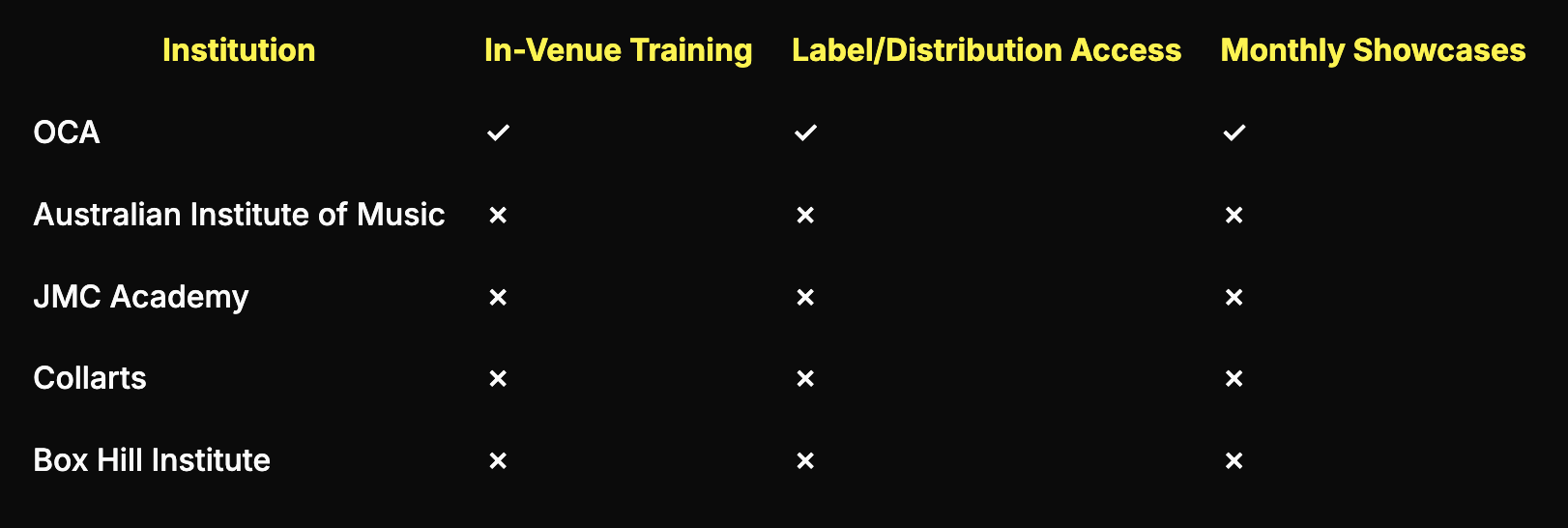
OCA students perform at the Music Makers Club monthly showcase, gaining real stage experience while their classmates handle event management, promotion, and production. This approach means everyone graduates with both performance credits and industry operations experience.
OCA features
Cert IV Pathways: OCA offers the only Cert IV in Music in NSW. Complete this Cert IV as a stepping stone to a Diploma.
In-venue training at Oxford Art Factory: You learn where real shows happen, not in a sterile practice room disconnected from the industry.
Gallery Bar Records label access: Release your music through OCA's in-house label with no upfront costs and keep up to 100% of net profits as a student.
Boutique Studio Access: Undertake Hands-on Artist Development at AMG Studios, define your artistic direction and produce a strong record.
Monthly emerging artist showcases: Perform on the Oxford Art Factory stage or work behind the scenes on event coordination and promotion.
Quarterly micro-grants: Apply for Audience Capture or Market Alignment grants to fund your creative projects.
Free entry to four gigs monthly: Build your network and develop your ear by attending professional shows at Oxford Art Factory.
OCA pros and cons
Pros:
Graduate with a nationally recognised Certificate IV in Music while building a real portfolio
Access professional venue and studio facilities throughout your studies
Release music through Gallery Bar Records with artist-friendly profit sharing
Cons:
Campus-based components are located in Sydney's Surry Hills area, which may require travel for regional students
The one-year program moves quickly and requires consistent engagement with coursework
Audition and interview required for entry, though no ATAR is needed
2. Australian Institute of Music: Offers degree programs across multiple disciplines
The Australian Institute of Music (AIM) runs bachelor and diploma programs covering performance, composition, music business, and creative technology. Students can pursue classical or contemporary pathways within their chosen specialisation.
AIM also offers an online undergraduate certificate for those who cannot attend campus regularly. The institution caters to a range of experience levels, from beginners exploring their interests to graduates seeking postgraduate qualifications.
Australian Institute of Music features
Bachelor of Music options: Choose from performance, composition, music business, or creative technology majors
Diploma pathways: Complete a one-year diploma as a stepping stone to a bachelor's degree
Online study available: Access undergraduate certificate programs fully online
Australian Institute of Music pros and cons
Pros:
Multiple degree options allow students to specialise in their area of interest
Diploma programs can serve as entry points into bachelor's degree study
Postgraduate options available for those wanting to advance further
Cons:
Bachelor's programs require a two to three year commitment compared to certificate courses
Campus locations are limited to specific capital cities
Performance students may have fewer venue-based learning opportunities during coursework
3. JMC Academy: Features diploma and degree programs in music production
JMC Academy operates campuses in Sydney, Melbourne, and Brisbane, offering music production courses at diploma and bachelor's level. The curriculum covers DAW training, composition techniques, and studio recording across their programs.
Students working through JMC's music production track learn technical skills for creating and engineering tracks. The academy also offers a combined Bachelor of Music and Bachelor of Entertainment Business Management for those wanting to study both creative and commercial aspects together.
JMC Academy features
Multi-campus network: Study in Sydney, Melbourne, or Brisbane depending on your location
Combined degree option: Pursue music and entertainment business management simultaneously
Production-focused curriculum: Training covers industry-standard DAWs and studio techniques
JMC Academy pros and cons
Pros:
Three campus locations make the academy accessible across Australia's east coast
Diploma programs allow for shorter study periods than full degrees
Combined degree option covers both creative and business skills
Cons:
Bachelor's programs extend over two years (six trimesters)
Production courses may emphasise studio work over live performance experience
No regional or Western Australian campus locations
4. Collarts: Includes online study options with audio production focus
Collarts operates from Melbourne and offers courses in audio production, music performance, music production, and entertainment management. The institution has partnerships with Avid (Pro Tools), SSL, and Dolby for certification programs embedded within their courses.
Students at Collarts can choose between on-campus, online, or blended delivery formats. Their audio production program covers studio engineering, post-production, and live sound work.
Collarts features
Industry certifications: Become Pro Tools certified and SSL certified as part of your coursework
Flexible delivery: Choose from online, on-campus, or hybrid study modes
Dolby Atmos facilities: Access immersive audio production training in their Melbourne studios
Collarts pros and cons
Pros:
Online study options suit students unable to relocate to Melbourne
Industry certifications add credentials beyond the degree itself
Double degree options available for broader skill development
Cons:
Single campus location in Melbourne limits face-to-face options for interstate students
Online-only students miss out on studio and venue access
Entertainment management focus is separate from performance tracks
5. Box Hill Institute: A TAFE option with certificate music programs
Box Hill Institute operates as a public TAFE in Victoria, offering Certificate III and Certificate IV in Music (Performance) programs. The TAFE pathway suits students looking for accredited vocational training within the public education system.
Their music programs cover performance fundamentals and can articulate into higher education pathways. Box Hill also offers related courses in sound production and audio engineering.
Box Hill Institute features
TAFE accreditation: Study within Victoria's public vocational education system
Certificate III entry point: Start at a lower level before progressing to Certificate IV
Pathway options: Credits may transfer toward further study at universities or private colleges
Box Hill Institute pros and cons
Pros:
Public TAFE funding may reduce course fees compared to private providers
Certificate III allows entry for students building foundational skills
Established institution with long history in vocational education
Cons:
Located in Victoria's Box Hill suburb, requiring Melbourne-area residency or relocation
TAFE environment may offer fewer direct industry venue connections
Performance focus may not suit students prioritising production or business skills